Mortgage Deferrals Now Recorded on Credit Reports

Diane Buchanan • July 29, 2020
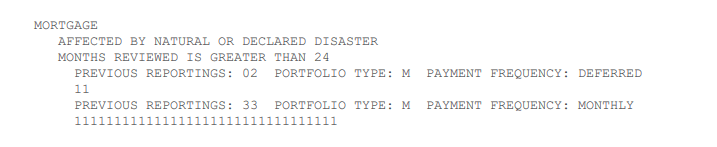
If COVID-19 has negatively impacted your finances and you're currently deferring your mortgage payments, you should know that this will be visible on your credit report. Here is an image from a recent credit report.

In this scenario, it shows that the mortgage was paid as agreed monthly for 33 months before being deferred for the last two months. It also shows that mortgage payments are currently in deferral.


Some may consider the credit bureau reporting a deferred status as good news. As COVID-19 hit like a freight train, many financial experts wondered about reporting errors on credit bureaus as a result of deferred payments. The fact that there is a system in place to report deferrals is a good sign.


Deferring your mortgage payment won't lower your credit score, but reporting errors from deferrals might. Once you've resumed your payments, it's a good idea to get a copy of your credit report to check for errors.


So, why does this matter to me now?


If you're considering a change to your mortgage, most lenders will be very hesitant to consider lending you new money when you aren't able to make your existing mortgage payments. This will be the case if you are looking to purchase a new property, renew, or refinance your current mortgage.


In fact, some lenders expect to see a history of regular repayment on any previously deferred loans before proceeding with any new application. Length of time after deferral varies by lender. This would include any debt payments (loan, line of credit, credit card) that have been deferred as well.


If changes to your mortgage are on the horizon, you need to have resumed all your regular debt payments before it will be possible to secure new mortgage financing.


If you'd like to discuss your personal financial situation with me, please contact me anytime!

DIANE BUCHANAN
Mortgage Broker

LET'S TALK
By Diane Buchanan March 4, 2026
Fixed vs. Variable Rate Mortgages: Which One Fits Your Life? Whether you’re buying your first home, refinancing your current mortgage, or approaching renewal, one big decision stands in your way: fixed or variable rate? It’s a question many homeowners wrestle with—and the right answer depends on your goals, lifestyle, and risk tolerance. Let’s break down the key differences so you can move forward with confidence. Fixed Rate: Stability & Predictability A fixed-rate mortgage offers one major advantage: peace of mind . Your interest rate stays the same for the entire term—usually five years—regardless of what happens in the broader economy. Pros: Your monthly payment never changes during the term. Ideal if you value budgeting certainty. Shields you from rate increases. Cons: Fixed rates are usually higher than variable rates at the outset. Penalties for breaking your mortgage early can be steep , thanks to something called the Interest Rate Differential (IRD) —a complex and often costly formula used by lenders. In fact, IRD penalties have been known to reach up to 4.5% of your mortgage balance in some cases. That’s a lot to pay if you need to move, refinance, or restructure your mortgage before the end of your term. Variable Rate: Flexibility & Potential Savings With a variable-rate mortgage , your interest rate moves with the market—specifically, it adjusts based on changes to the lender’s prime rate. For example, if your mortgage is set at Prime minus 0.50% and prime is 6.00% , your rate would be 5.50% . If prime increases or decreases, your mortgage rate will change too. Pros: Typically starts out lower than a fixed rate. Penalties are simpler and smaller —usually just three months’ interest (often 2–2.5 mortgage payments). Historically, many Canadians have paid less overall interest with a variable mortgage. Cons: Your payment could increase if rates rise. Not ideal if rate fluctuations keep you up at night. The Penalty Factor: Why It Matters More Than You Think One of the biggest surprises for homeowners is the cost of breaking a mortgage early —something nearly 6 out of 10 Canadians do before their term ends. Fixed Rate = Unpredictable, potentially high penalty (IRD) Variable Rate = Predictable, usually lower penalty (3 months’ interest) Even if you don’t plan to break your mortgage, life happens—career changes, family needs, or new opportunities could shift your path. So, Which One is Best? There’s no one-size-fits-all answer. A fixed rate might be perfect for someone who wants stable budgeting and plans to stay put for years. A variable rate might work better for someone who’s financially flexible and open to market changes—or who may need to exit their mortgage early. Ultimately, the best mortgage is the one that fits your goals and your reality —not just what the bank recommends. Let's Find the Right Fit Choosing between fixed and variable isn’t just about numbers—it’s about understanding your needs, your future plans, and how much financial flexibility you want. Let’s sit down and walk through your options together. I’ll help you make an informed, confident choice—no guesswork required.
By Diane Buchanan February 25, 2026
If you're a homeowner juggling multiple debts, you're not alone. Credit cards, car loans, lines of credit—it can feel like you’re paying out in every direction with no end in sight. But what if there was a smarter way to handle it? Good news: there is. And it starts with your home. Use the Equity You’ve Built to Lighten the Load Every mortgage payment you make, every bit your home appreciates—you're building equity. And that equity can be a powerful financial tool. Instead of letting high-interest debts drain your income, you can leverage your home’s equity to combine and simplify what you owe into one manageable, lower-interest payment. What Does That Look Like? This strategy is called debt consolidation , and there are a few ways to do it: Refinance your existing mortgage Access a Home Equity Line of Credit (HELOC) Take out a second mortgage Each option has its own pros and cons, and the right one depends on your situation. That’s where I come in—we’ll look at the numbers together and choose the best path forward. What Can You Consolidate? You can roll most types of consumer debt into your mortgage, including: Credit cards Personal loans Payday loans Car loans Unsecured lines of credit Student loans These types of debts often come with sky-high interest rates. When you consolidate them into a mortgage—secured by your home—you can typically access much lower rates, freeing up cash flow and reducing financial stress. Why This Works Debt consolidation through your mortgage offers: Lower interest rates (often significantly lower than credit cards or payday loans) One simple monthly payment Potential for faster repayment Improved cash flow And if your mortgage allows prepayment privileges—like lump-sum payments or increased monthly payments—those features can help you pay everything off even faster. Smart Strategy, Not Just a Quick Fix This isn’t just about lowering your monthly bills (although that’s a major perk). It’s about restructuring your finances in a way that’s sustainable, efficient, and empowering. Instead of feeling like you're constantly catching up, you can create a plan to move forward with confidence—and even start saving again. Here’s What the Process Looks Like: Review your current debts and cash flow Assess how much equity you’ve built in your home Explore consolidation options that fit your goals Create a personalized plan to streamline your payments and reduce overall costs Ready to Regain Control? If your debts are holding you back and you're ready to use the equity you've worked hard to build, let's talk. There’s no pressure—just a practical conversation about your options and how to move toward a more flexible, debt-free future. Reach out today. I’m here to help you make the most of what you already have.